
AI-Native Arthroplasty
Every year, over 1 million Americans receive a knee replacement.
Nearly all of them lose their ACL — the ligament that makes a knee feel like a knee.
We're changing that.
The Problem
The best knee replacement exists.
Almost no one gets it.
A Bicruciate-Retaining (BCR) knee replacement preserves both the ACL and PCL — giving patients the most stable, natural-feeling knee possible.
But BCR is significantly more complex than conventional TKA. Surgeons must navigate tighter anatomical constraints, perform hybrid measured-resection and gap-balancing techniques, and commit to tibial rotation earlier in the procedure. A poorly balanced BCR risks manipulation under anesthesia, poor satisfaction, and early revision.
Over thousands of cases, expert surgeons develop an intuition for BCR. But the vast majority of orthopedic surgeons will never perform enough BCR procedures to reach that level.
“Optimal ligament balancing for an ACL- and PCL-preserved knee has yet to be defined.”
— De Windt et al., Applied Sciences, 2022
Conventional TKA
- ✕ACL sacrificed in nearly all procedures
- ✕PCL sacrificed in ~50% of procedures
- ✕Forced choice between measured resection or gap balancing
- ✕~20% patient dissatisfaction rate
What Cartan Is Building
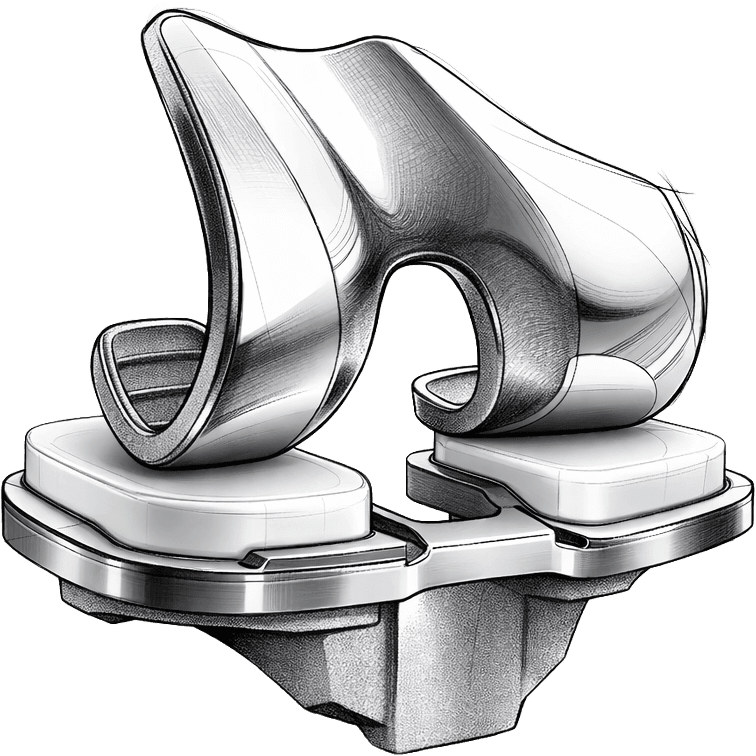
- →Preserving both ACL and PCL as the design goal
- →AI-guided planning adapted to individual anatomy
- →Instrumented feedback during the procedure
- →Designed to make BCR accessible to more surgeons
Design concept — not cleared by FDA
What if every surgeon could perform BCR like an expert?
Pre-Operative — Step 1
Build the Digital Twin
AI agents ingest patient imaging and kinematic data to construct a physics-based digital twin — a complete biomechanical model of the patient's knee.
Specimen Data
Imaging Pipeline
AI Agent
Pre-Operative — Step 2
50-Year Simulation
The AI stack is designed to simulate the post-operative knee across a 50-year horizon — exploring wear, stress, and failure modes before the first incision.
Surgeon Parameters
Surgeons review and adjust the proposed plan. Each change triggers an updated simulation with new confidence intervals.
Intra-Operative
Smart Surgery
AI agents track surgical state in real time, provide precise cutting guidance, dynamically update the plan with intraop data, and verify every step against prescribed thresholds.
Workflow Tracker
Smart Instruments — Live
Intraop bone hardness measurement integrated. Confidence interval updated: 97.2% → 98.1% survivorship.
AI Guidance
If the surgeon decides to convert from BCR to CR or UC during the procedure, the AI instantly modifies the surgical plan for seamless transition.
Post-Operative
The Learning Loop
After surgery, AI agents are designed to continue working — collecting outcomes, monitoring for complications, generating PT protocols, and feeding real-world data back into the digital twin.
Patient Recovery Timeline
Post-op data feeds back into the digital twin, enabling comparison between simulated and actual outcomes. Designed to improve with each case.
Illustrative data shown for demonstration purposes
Complication Monitor
All risks below threshold. No intervention needed.
AI Agent
The Vision
Every procedure makes every future procedure better.Every procedure makes every
future procedure better.
Each case generates pre-, intra-, and post-operative data that flows back into the AI stack. De-identified and aggregated, this data continuously improves predictions, surgical plans, and patient outcomes — creating a compounding advantage that deepens with every surgery.
Product Roadmap
This is what AI-native means.
Not AI-assisted. Not AI-enabled. The implant, the instruments, and the intelligence are co-designed from the ground up — each making the others better.